
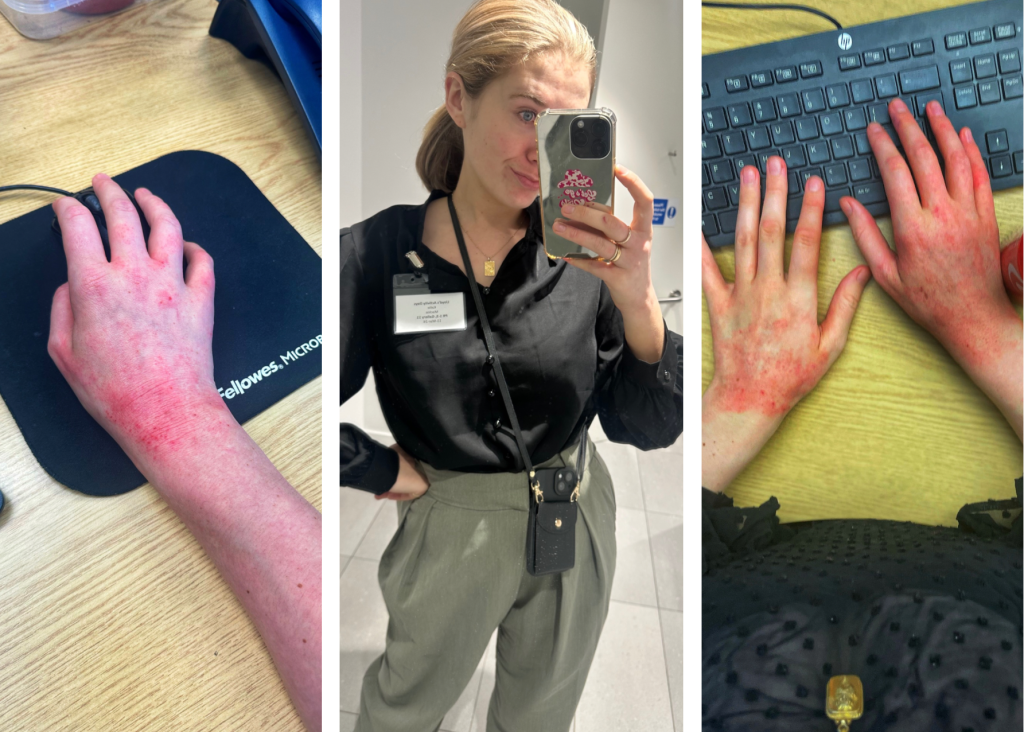
‘The talk’ 😉Firstly, remember your skin is just a small part of you, and your friends and family are there to offer support – no need to feel guilty about discussing your feelings.
When chatting about eczema, it’s essential to keep things simple and honest. If the other person isn’t familiar with it, you can start by sharing some basics. For example, mention that eczema isn’t contagious and that it’s actually an umbrella term for different conditions, so it varies from person to person. Highlight a few key points without bombarding them with too much at once. Also, think about what you’d like to know and offer to address any questions they may have, whether it’s right then and there or later on, so they have time to absorb everything.
You only need to tell them if you want to, and only share what you feel comfortable sharing. It’s all on your terms.
WORK;
They may know you have a skin condition but not necessarily how it impacts and affects you. Sharing with your employer can really make a positive impact on your work life! It’s important to think about what you hope to achieve by sharing this personal aspect of your life. Whether it’s for understanding, support, or to request workplace adjustments, being clear on your goals can help guide the conversation.
Opening up about how eczema affects you can lead to more support and understanding from your employer when you need it most. I used to practice scenarios to calm my anxiety about talking about my skin. You don’t have to divulge all the details – just focus on how eczema impacts your job.
Learning to communicate your needs and boundaries effectively, whether it’s with friends, family, or at work, is so empowering. It can help you get the support and treatment you truly deserve. So don’t hesitate to be open and communicate clearly about your eczema journey.
POV: Barely able to concentrate and get much done in the day because of constant discomfort leading to itching from a flare-up?
Instead of simply saying that you’re feeling very itchy to your manager, it’s best to explain to them that you are experiencing a flare-up of your medical condition, which is impacting your ability to work.
If necessary, inform your manager that you may need to take sick time due to the flare-up, which is a legitimate use of sick time. The fact that your medical condition may not be well understood does not change the legitimacy of taking sick time in such situations.
When dealing with a flare-up, it’s beneficial to inform your colleagues about how they can support you and provide them with information about eczema. Addressing potential misunderstandings and setting expectations early on is important in avoiding awkward situations later. It may be daunting at first, but initiating this conversation is crucial.
You should not feel embarrassed about your condition. Instead, explain that there will be times when it will affect your ability to work and that you may need to take sick leave during those times. Be open about the severity of the condition and discuss the appropriateness and effectiveness of taking time off.
Honesty is essential—communicate your needs. Sometimes, taking a break is all you need to come back stronger. 💪
Advice for support networks/ colleagues:
- Listen to what works best for each individual. Do not offer unsolicited advice unless asked.
- Avoid mentioning someone’s skin unless they bring it up.
- Be patient and understanding.
Advocacy is not just about awareness but also your mental well-being. Building resilience and self-advocacy skills help navigate challenges with itchy skin. I’ve cultivated a supportive work environment, asking for help and taking time off when needed.
BIG LOVE, 𝕋𝕙𝕖 𝕀𝕥𝕔𝕙𝕪 𝔹𝕚𝕥𝕔𝕙,
AKA @Mackies_Moments❤️💌
P.S. being able to work from home has been a godsend for me, means I can work and slug to my hearts desire without claiming a sick day!
EXTRA LINKS;
For help dealing with colleagues’ reactions to your eczema, the charity Changing Faces has a page entitled ‘Managing challenges at work connected to your visible difference’ (www.changingfaces.org.uk).
Employer not helping?;
Reminder, Creating a working environment where employees can safely do their jobs is part of an employer’s Duty of Care under the Health and Safety at Work Act 1974.
The location of your workspace is important, as being seated in/near direct heat or cold sources such as a window or radiator can aggravate skin conditions. It is reasonable to request to a workstation where this isn’t the case.
Cleansing products, such as industrial cleansers, can be an irritant to the skin. If it is not possible to avoid using them altogether, you may need gloves or other barrier protection/other special measures to protect your skin. Alternatives to industrial cleansers are available and you may request this from your employer, but this may require a referral to occupational health for a more thorough assessment.
Additionally, The Equality Act 2010 sets out when someone is considered to be disabled and protected from discrimination. The definition is quite wide – so check it even if you don’t think you’re disabled. For example, you might be covered if you have a learning difficulty, skin disease (includes all conditions that irritate, clog or damage your skin… like eczema) ,dyslexia or autism.

 Itch N Bitch